
8 Ways to Handle Client Ghosting (And How to Get the Project Back on Track)

You had a great discovery call, the client was excited about starting to work with you, and they paid their deposit with no hesitation - they seemed like an ideal client…
Then they ghosted you.
Multiple follow-ups later, and you’re pulling your hair out. You’re left asking yourself, “what can I do to get this project back on track?”
During our Peer Mastermind calls in Creative Maven Society we’ve had a couple of our members ask similar versions of this question.
There are 2 general types of ghosting that we see most often for creative service providers (photographers, web designers, service pros, etc):
- Communication - during the “information gathering” phase of any creative service project, you need a client to share what their needs are in much more specific detail than you covered during a discovery call. This could be things like surveys, mood boards, or even branding, that feel like you’re pulling teeth to get from the client.
- Payment - payment plans are fantastic for helping clients stomach the price of working with you, but for a select few clients, getting them to actually make the payments can be near impossible.
Based on the conversations we’ve had in The Breakroom, here are 4 things you can do to prevent each type of ghosting.
What to do when a client stops replying?
This is what we’re loosely calling communication ghosting. Your project has ground to a halt because you’re waiting on the client to give you information to properly plan their photoshoot, design their website, or even build out the automations they paid you to create.
Option 1: Structural changes - do it together
Early on in our time running a branding photography business, we realized that people struggle to prioritize filling out a prep questionnaire, and we ended up having to ask follow-up questions to many of their answers during our strategy call anyway. We added 15 mins to our strategy call to plan their photoshoot and asked them all the questions at the beginning of the call when we had their undivided attention, and just got rid of the survey all together.
In the end, it saved us time by just “holding their hand” to answer the question, rather than having to spend a few minutes sending a follow-up every couple of days over the course of weeks just trying to get a survey completed.
Option 2: Format changes - make it their preferred communication method
Something I frequently have to remind myself is “done is better than perfect”. If you’re struggling to get a client to reply to an email, maybe that’s because they don’t communicate the way you do.
We had a client who point-blank told me at one point, “If you need a quick response from me, don’t text me - I’ll reply to an email within 10 mins, but text messages could be days before you’ll get a reply from me”. While that may not be how I use those channels to communicate, by playing by his rules, I would always get a quick response after that point.
The one format that a lot of people forget is voice messages. If you’re struggling to get someone to fill out a survey, experiment with asking them if it’d be easier for them to just send you a voice memo with all the answers (there are plenty of tools to transcribe VMs). This could make it easier for them to give you a much more thought-out response while they’re out on a walk or sitting in a car doing errands, rather than feeling like they have to be sitting at a desk to type up what you need from them.
Option 3: Gamification changes - put a reward behind what you need
When Jo had her first custom website made for her boudoir photography business, the web designer attached a Starbucks gift card to the forms with all the information she needed to fill out. With a simple message along the lines of, “I’m asking you to think through a bunch of questions, let me buy you coffee so you can take yourself out and actually get it all done in one sitting”.
This could be something as simple as a Starbucks gift card, you could partner with a spa for a “completion reward”, or even have a little merch shop where they get to choose one branded item (for free) when they complete whatever the thing you need them to do. The more aligned to your ideal clients, the better.
Option 4: Contractual changes - add a “pause” clause
An option you don’t want to enforce but should definitely have in place is having a “pause” clause in your contract that states that after a specific number of days after a missed deadline, the project will be paused. This generally comes with 2 consequences 1) there will be a re-start fee when the client wants to actually continue, and 2) their timelines will be pushed because you can’t hold delivery/launch deadlines if they’re not providing you what you need in time. For certain businesses, there can be a 3rd consequence that the client is responsible for any costs associated with rescheduling if you were traveling to them or had rentals (eg: studio).
What to do if a client misses payments?
Payment plans are a double-edged sword - they make sales easier because the day 1 cost is much lower. But then you have to figure out how to make sure you get paid… Here are 4 things you can do to make it much easier to make sure you actually get fully paid.
Option 1: Require Autopay
This may seem like a little thing, but a lot of missed payments aren’t malicious; the client just forgot. In your contract & invoice template, if you just require that they set up automatic payments, most people won’t even notice. Since we started turning autopay on, we’ve had only a few people reach out and ask if they could do non-autopay.
Option 2: Give a small discount for paying in full
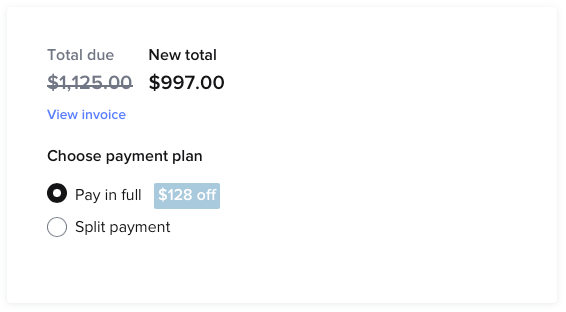
In Honeybook (our preferred CRM), in the payment screen we can give people the option when signing their contract if they want to do a paid-in-full option or if they want to split out through a payment plan. And we can give a percent or dollar amount discount if they choose to pay in full. With something as small as a $100 discount on a $1200 group program, we’ve found a lot of people will choose to pay in full, and then we don’t have to even worry about following up with people about future payments.
Option 3: Milestone-based billing
Most people do payment plans by equally spreading the total cost over the length of the project, with monthly or weekly payments. While this is simpler, it doesn’t give the clients a feeling that they’re directly getting something for making that payment - if you go to milestone-based payment plans, that would mean dividing up the project into phases with payments due at the beginning (or end) of each phase. For example, a photographer could have a plan like deposit - to book, payment 1 - before strategy call, payment 2 - before the session, and payment 3 - before delivery of the gallery. That way if the payment doesn’t get paid, you can simply say the next phase won’t start until the payment is made (and if the session is pushed back, they’d pay any rescheduling fees)
Option 4: Outsource the headache
If you’ve run out of options, you can use a Buy Now Pay Later option like Afterpay (integrated into many payment processors) to offer people a payment plan option of their choice. You’d still get paid in full up front minus a larger processing fee, but then if/when your client misses payments in the future, the Buy Now Pay Later company would be following up with them since they effectively took out a loan to work with you. Personally, we’ve chosen not to do this, but it is an option if you don’t have any other options.
But what can I do today?
Okay, so these options are things you can do to prevent ghosting in the future - if you’re trying to figure out what to do with your current clients, we’d follow a simple approach:
- Set a deadline & clear (documented) description of what will happen if they don’t take the necessary actions by then. And I’d email it & send it in their preferred communication format.
- Send 5-7 follow-ups before your set deadline, doing your best effort to restart the project (if they’re a business with multiple employees, try and reach out to someone else in case someone went on leave and didn’t tell you)
- Be prepared to walk away - for most things, it’s easier to book a new project and move on than devoting all your time stressing over if a project will restart (or not)
- Send them a final follow-up with a clear breakdown of what restarting would look like & what would be required of them
Throughout this whole process, try to approach it from a place of understanding rather than accusation - remember everybody has a life outside of your project and there could be a thousand reasons why they're ghosting you. Ruining a relationship just because their kid spent two weeks in the hospital and hasn't been checking their email is a real possibility if you’re mean about it.
If you’re a creative service provider & want a place to connect with peers and talk about questions like this on a weekly basis, check out Creative Maven Society. Feel free to shoot us a DM on IG @joandlyndon if you have any questions.